
E.E. Ward Moving & Storage
Best Suburbs of Miami - 3 Character Types to Choose From
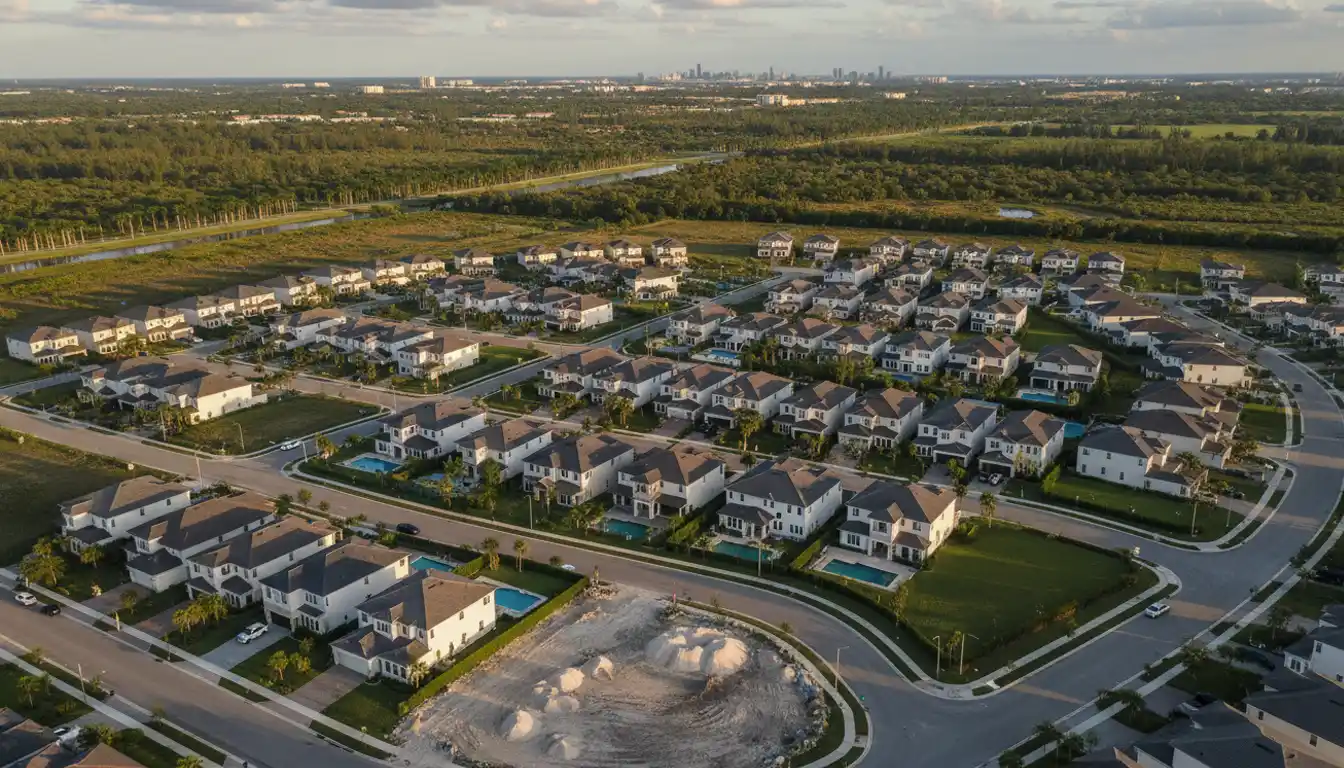

The best suburbs of Miami are no longer just those with the best schools or quietest streets. Today, the smartest choice involves future-proofing your investment by considering a community’s elevation, its strategy for managing growth, and its integration with the urban core, making for a more complex but crucial decision.
The Redefinition of 'Suburb': Why the Old Maps No Longer Work in Miami, FL
For decades, the concept of a Miami suburb was straightforward: a leafy, quiet community of single-family homes distinct from the bustle of Downtown or the glamour of Miami Beach. It was a choice defined by what it wasn't. Today, that definition is becoming increasingly irrelevant. The traditional lines separating Miami's urban neighborhoods, independent cities, and suburban towns have blurred into a complex, interconnected region, forcing us to rethink what a suburb truly is.
At E.E. Ward Moving & Storage, we've had a front-row seat to this evolution. Since our founding in 1881, we've helped generations of families relocate throughout South Florida, and we've seen the landscape—both literally and figuratively—transform. What was once a clear-cut choice between city life and suburban tranquility is now a spectrum of options, each with its own unique character and set of considerations.
This shift is driven largely by a unique geographical reality. Miami's urbanized area is geographically constrained, about 100 miles long but in some areas only 5 miles wide, squeezed between the Atlantic Ocean and the Everglades. This narrow corridor for development means that as the population grows, communities don't just expand outward; they grow into one another. A city like Doral now has a dense, urbanized core of its own, while a historically urban neighborhood like Coconut Grove offers a tree-canopied, suburban feel. This blending creates a dynamic but often confusing real estate market for those looking to find their perfect home.
The result is that a "suburb" in Miami-Dade County might be a waterfront village like Key Biscayne, a sprawling master-planned community in the west like Weston in Broward County, or a historic city like Coral Gables that feels like its own metropolitan center. The key to making a confident decision is to move beyond outdated labels and analyze what each community offers for the future.
Choosing Higher Ground: The Most Valuable Amenity You're Not Thinking About
When families look at homes for sale in South Florida, the checklist is familiar: good schools, low crime rates, proximity to parks, maybe a pool. But in 2026, the most critical long-term amenity is one you can't see on a property tour: elevation. As discussions around climate resilience become more urgent, choosing higher ground is emerging as the single most important factor in future-proofing your real estate investment.
This isn't about distant, abstract threats. It's about the practical realities of living in a low-lying coastal region. Issues like "sunny day flooding," where high tides push water up through storm drains, are already a reality in many areas. Rising insurance premiums and evolving building codes are direct financial consequences that homeowners are facing right now. For anyone considering purchasing a home, understanding a property's elevation is as crucial as a home inspection.
Fortunately, much of Miami was built with this in mind, even if early developers didn't use the term "climate resilience." The urban areas of Miami and its suburbs are situated on a slightly higher ridge, ranging from 2 to 7 meters above sea level. This Atlantic coastal ridge, a strip of limestone running from north to south, has historically been the most desirable and stable ground for development. Communities built along this ridge, like parts of Pinecrest, South Miami, and Coral Gables, often have a natural advantage in drainage and flood mitigation.
Viewing elevation as a key factor shifts the property search. It encourages buyers to look beyond the immediate appeal of a waterfront property and ask critical questions about its long-term viability. It adds a new layer to assessing home value, one that considers not just the current market but the sustainability of the community for decades to come. When you choose a home in a Miami suburb, you are making a bet on its future, and elevation is a powerful indicator of its stability.
The Growth Paradox: Navigating Miami's Relentless Expansion
Miami's growth is staggering. It’s a city defined by an energy that draws people from around the world, fueling a vibrant culture and a dynamic economy. The numbers are a testament to this appeal: Between 1970 and 2016, the population of the Miami Metropolitan Statistical Area increased by over 378%, growing from 1,267,792 to 6,066,387. That relentless influx of new residents continues today, creating what we call the Growth Paradox—a situation where the very factors that make the region attractive also create immense pressure on its infrastructure, affordability, and quality of life.
On one hand, this explosive growth creates incredible opportunity. New construction homes are constantly being developed, particularly in the western suburbs pushing toward the Everglades. This expansion offers more housing options, often at a more accessible median home price than established coastal neighborhoods. It fuels job creation and brings new shopping centers, dining, and recreational facilities to once-sleepy areas.
On the other hand, the consequences of this growth are felt every day by residents. The strain on roads leads to some of the nation's longest commute times. The demand for housing has far outpaced supply, leading to a severe affordability crisis. As a clear indicator of this pressure, by June 2023, the Miami metropolitan area ranked as the 2nd most expensive area to rent in America, with the median asking rent having increased 27% since 2019. This impacts not only renters but also potential homebuyers, as high rents make saving for a down payment increasingly difficult.
This growth has also not been equitable, a fact with deep historical roots. Historically, Miami's development was shaped by exclusionary policies; by 1930, restrictive covenants confined most of the city's 29,000 black residents to a small area known as 'Colored Town' (now Overtown). The legacy of these policies, combined with modern economic pressures, means that the benefits of growth are not shared equally. Today, Miami-Dade County officially recognizes 23 communities as 'Targeted Urban Areas' that require focused efforts for economic improvement, indicating the uneven impact of regional growth.
For anyone considering a move to a Miami suburb, understanding this paradox is essential. It means looking past the glossy brochures of new developments and asking hard questions about a community's long-term plan. How is the school district handling the influx of new students? What investments are being made in public transit and road improvements? Is the community building resiliently, or is it simply expanding at an unsustainable pace?
The Three Miami Suburban Archetypes: Finding Your Perfect Fit
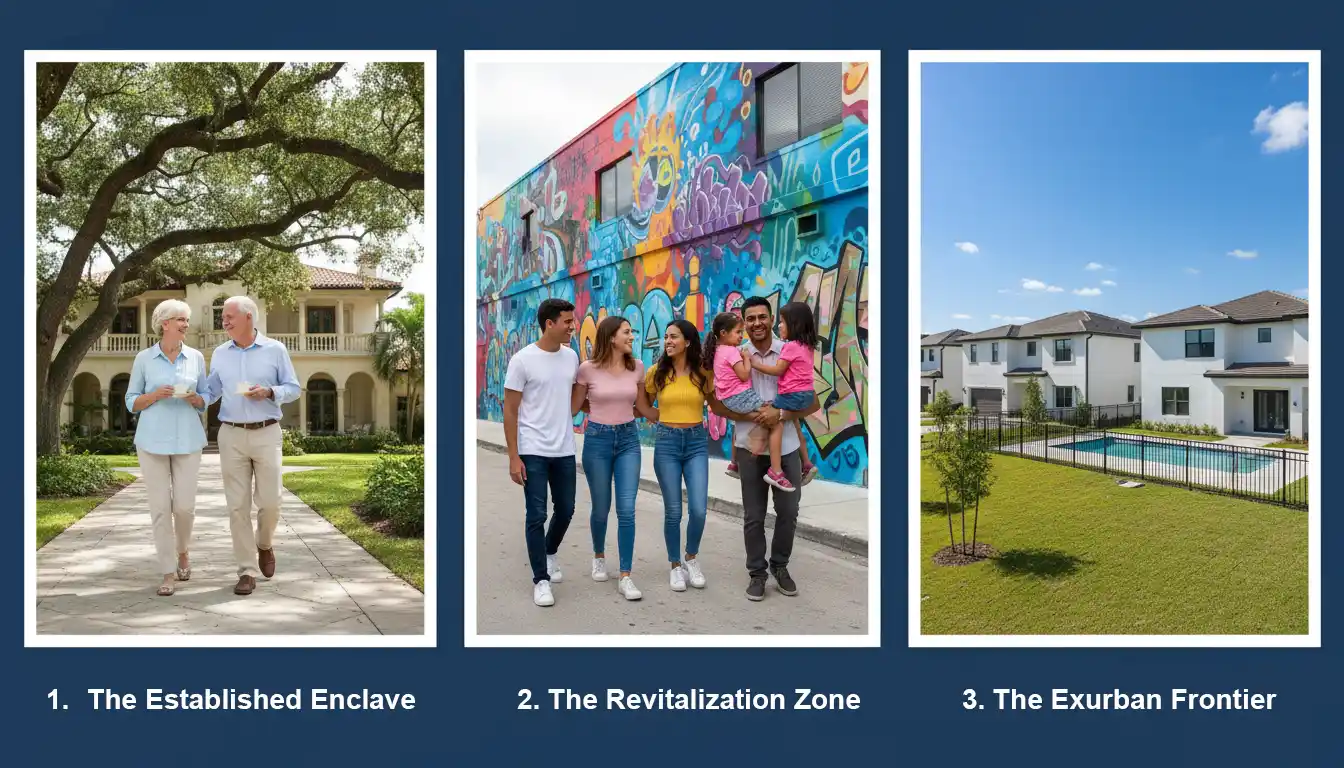
To help you navigate this complex landscape, we've moved beyond simple "best of" lists. Instead, we've analyzed the suburbs of Miami and grouped them into three distinct archetypes. Understanding which archetype aligns with your priorities, budget, and lifestyle is the first step toward making a confident decision. This framework answers the question "What are the suburbs of Miami?" by grouping them based on their character and the opportunities they offer.
1. The Established Enclave
These are the communities that often come to mind when one thinks of classic, affluent Miami suburbs. Characterized by mature tree canopies, strong municipal governments, and a long history of high property values, these areas represent stability and prestige. They are the blue-chip stocks of Miami real estate.
- Examples: Coral Gables, Pinecrest, Key Biscayne, Palmetto Bay.
- The Appeal: The primary draw for many families is the access to some of the best public and private schools in South Florida. These communities boast A-rated schools and a well-funded school district. They are also considered among the safest neighborhoods, with dedicated police forces and active community involvement. The housing stock is dominated by spacious single-family homes, many with significant architectural character. Parks and recreation facilities are typically abundant and well-maintained.
- The Trade-offs: The biggest barrier to entry is cost. The median home price in these areas is significantly higher than the county average. The value is undeniable, but the price is steep. Because they are largely built-out, there are fewer new construction homes, and many properties may require updates. While many of these neighborhoods are on the higher-elevation coastal ridge, certain low-lying waterfront properties can still be vulnerable.
- Best for: Families who prioritize top-rated schools and a quiet, stable community above all else, and who have the budget for luxury homes in an established market.
2. The Revitalization Zone
These are dynamic, evolving communities, often located closer to Miami's urban core. They are a mosaic of old and new, where historic homes sit near brand-new townhomes and condos. These zones are defined by transformation, offering both significant opportunities and a degree of uncertainty.
- Examples: South Miami, parts of Kendall near the Dadeland urban core, Surfside, and even traditionally urban neighborhoods like Coconut Grove that are densifying while retaining a suburban feel.
- The Appeal: The primary attraction is the potential for both lifestyle and financial appreciation. As these areas gentrify, they attract new dining, shopping, and cultural amenities, creating a vibrant, walkable neighborhood vibe. Proximity to Downtown Miami and Brickell is often much better than from the exurbs, making for shorter commute times. The housing stock is diverse, offering everything from classic bungalows to modern townhomes for sale, which can provide a more accessible entry point to the market.
- The Trade-offs: Development can be uneven. The quality of life, school performance (GreatSchools rating can vary widely), and public services can differ significantly from one block to the next. The "revitalization" process can also create friction within the community and lead to rising property taxes and cost of living that displaces long-time residents. Growth can feel chaotic if not managed well by the local city government.
- Best for: The Hybrid Urbanite, young professionals, and investors who are excited by a dynamic community and see the long-term value in an area's transformation. This archetype offers a chance to find a home close to the action without the price tag of Brickell or Miami Beach.
3. The Exurban Frontier
This archetype represents the leading edge of Miami's westward and southward expansion. These are often large, master-planned gated communities built on former agricultural land, defined by newness and a family-centric design. They are the engine of new housing supply for Miami-Dade and Broward County.
- Examples: Doral, parts of West Kendall, and communities in Broward County that are functionally Miami suburbs, like Weston.
- The Appeal: This is often the answer to "What is the affordable suburb of Miami?" for those seeking a large, new single-family home. The value proposition is clear: you get more square footage and a newer home for your money. These communities are designed for families, with built-in amenities like clubhouses, pools, golf courses, and community events. Schools are often new and well-equipped to handle the growing population.
- The Trade-offs: This is where the Growth Paradox is most acute. The primary drawback is the commute. Daily traffic to the business centers in the east can be grueling. While these communities are meticulously planned internally, the external infrastructure (highways, public transit) often struggles to keep pace with the rapid development. The "cookie-cutter" feel of some developments may not appeal to everyone, and there is a heavy reliance on cars for nearly every errand.
- Best for: Families prioritizing a new construction home and maximum living space for their budget, who are prepared for a significant commute or have flexible work arrangements.
Comparing the Decision Factors: Old vs. New
Choosing the right suburb requires balancing timeless needs with modern realities. To help you weigh your priorities, we’ve structured a comparison between the traditional criteria that have always mattered and the future-proofing criteria that are becoming increasingly vital for any home purchase in Miami, FL.
Traditional Criteria (The "What")
Schools & Safety: For decades, this has been the bedrock of suburban decision-making. Families research A-rated schools and compare crime statistics to find a secure environment. This remains a non-negotiable for many, and the Established Enclaves like Pinecrest and Coral Gables continue to lead in this area. It's a foundational element of long-term home value.
Home Size & Amenities: The classic suburban dream involves a spacious single-family home with a yard, a garage, and perhaps a community pool. This is the core appeal of the Exurban Frontier, where new developments offer the most modern amenities and square footage for the price, a value that is harder to find in the built-out, older suburbs.Future-Proofing Criteria (The "How and Where")
Elevation & Resilience: This is the new, critical factor. It's about a property's long-term physical and financial security. A home at a higher elevation on the coastal ridge may be more resilient to flooding, resulting in lower insurance costs and greater peace of mind. This factor forces a re-evaluation of waterfront properties and low-lying areas, adding a crucial layer of risk assessment to any purchase.
Growth Management & Infrastructure: This assesses how a community is planning for its future. Does the city have a comprehensive plan to manage traffic from new developments? Are they investing in parks, public transit, and upgrading utilities to support a larger population? A suburb with a smart growth strategy is a much better long-term bet than one that allows chaotic, unplanned expansion. This is a key differentiator between a well-managed Revitalization Zone and a struggling one.
Urban Integration & Access: This measures a suburb's true connection to the economic and cultural heart of the region. It's not just about miles, but about practical commute times to key hubs like Downtown, Brickell, and Miami International Airport (MIA). A community with multiple transit options and easy access to major highways offers a superior quality of life, a key strength of many Revitalization Zones and a primary challenge for the Exurban Frontier.
Making the Right Choice for Your Needs
There is no single "best" suburb of Miami. The right choice is deeply personal and depends entirely on your priorities, risk tolerance, and lifestyle. Based on our experience helping thousands of people relocate, here is tailored advice for three common types of buyers we encounter.
For the Climate-Conscious Relocator
Your primary concern is the long-term viability and safety of your property in the face of environmental changes. You should heavily prioritize the "future-proofing" criteria. Your search should begin with elevation maps and municipal resilience plans. Focus on Established Enclaves like Pinecrest and parts of Coral Gables that are situated on the Atlantic coastal ridge, away from canals and coastal flood zones. Ask your real estate agent for flood zone designations and insurance quotes upfront. A slightly smaller home on higher ground is a far wiser investment for you than a larger home in a more vulnerable location.
For the Growth-Weary Professional
You are concerned about the negative impacts of rapid development: unbearable traffic, crowded schools, and a decline in quality of life. You should be most cautious of the Exurban Frontier, where infrastructure often lags behind population growth. Your ideal fit may be an Established Enclave, where strict zoning laws and a stable population protect against chaotic change. Alternatively, a well-managed Revitalization Zone like South Miami, which has an established core and is investing in smart, transit-oriented densification, could offer a good balance of amenities without the unsustainable sprawl.
For the Hybrid Urbanite
You want the space and community feel of a suburb without sacrificing convenient access to the culture, dining, and career opportunities of the city. The Revitalization Zone archetype is tailor-made for you. Look for homes in walkable neighborhoods like Coconut Grove or near the urban centers of South Miami and Dadeland. Analyze commute times not just by car, but by Metrorail and other transit options. Your focus should be on townhomes, condos, or single-family homes that offer a blend of suburban comfort and urban accessibility, allowing you to enjoy the best of both worlds.
Ultimately, choosing where to live in the greater Miami area is one of the most significant decisions you will make. It requires careful research and a clear understanding of what truly matters to you and your family. With over 145 years of experience, E.E. Ward Moving & Storage has helped families navigate moves of all complexities throughout South Florida. We understand that you’re not just moving boxes; you’re moving your future. For a transparent quote and guidance from a team that knows every corner of Miami-Dade County, contact us today.

Get a Quick Estimate For Your Upcoming Move!
We are here to help! Fill out our Quick Moving Estimate inquiry form and our team will contact you soon with a free estimate. Contact the office moving company with over a century of moving experience. Whether it’s a local downtown move or long-distance relocation — including business moves — we’re ready to help.
